President Tsai Ing-wen yesterday poses for a picture with the relative of a 228 Incident victim at the Presidential Office in Taipei yesterday. Photo: CNA
President Tsai Ing-wen (蔡英文) yesterday said that the government would take the lead in investigating the 228 Incident and find those accountable for the tragic chapter in the nation’s history.
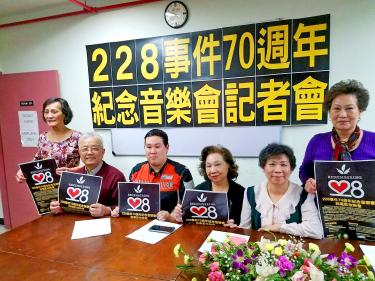
A group of overseas Taiwanese yesterday display placards during a news conference in New York City to promote a series of activities marking the 70th anniversary of the 228 Incident. Photo: CNA
China yesterday described 228 Incident protests as a ploy by Taiwanese independence forces to hijack commemorations of the 70th anniversary of the massacre.
Taiwan’s judiciary has long suffered from a malaise and a lack of public trust. The government’s national conference on judicial reform that started on Monday is the first real effort at reform since the failure of the national conference in 1999.
Hopefully, viable proposals to improve the judicial system and its operational efficiency will be made this time, so that the judiciary can win back public trust.
Nine months ago, President Tsai Ing-wen (蔡英文) and her administration took office. During the election, Tsai was praised for her calls to reform the judicial, pension and party asset systems.
To this day, there has been either no progress or it is painfully slow. There are two reasons for this: The wrong people have been assigned to initiate the reforms, and the reforms are being carried out in the wrong order.
Deity figures covered with mud are pictured in Linbian Township, Pingtung County, yesterday.
PHOTO: CNA
Disaster relief work in the aftermath of Typhoon Morakot is being complicated by the emerging threat of a swine flu epidemic, as an increasing number of flu patients are diagnosed and reported nationwide, including several aid workers.
The Ministry of National Defense said in a press release yesterday that 10 soldiers working in the Pingtung area had been diagnosed with swine flu.