Taiwan Tati Cultural and Educational Foundation

 
  • Increase font size
  • Default font size
  • Decrease font size
Home The News

News

Forum discusses DPP’s China, 2016 strategy


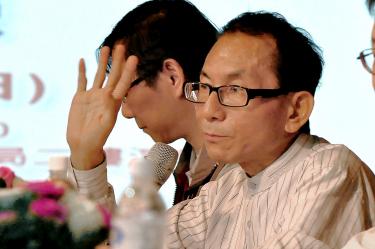
Ketagalan Foundation chairman Mark Chen speaks at a forum discussing the Democratic Progressive Party’s strategy for returning to power.
Photo: Liao Chen-huei, Taipei Times

Comparing the Democratic Progressive Party’s (DPP) China policy under former president Chen Shui-bian (陳水扁) and the party’s current policy is hard because of the rapidly changing dynamics of international politics, but there is no doubt that cross-strait policy during the Chen era was more than “eight lost years,” as some say, DPP members and academics said yesterday.

“The years between 2000 and 2008 were not lost years, but eight legendary, glorious years,” You Ying-lung (游盈隆), deputy executive director of the DPP’s think tank, told a forum in Taipei.

Read more...


Trade pact stalls on confidence: poll


A protester opposing a service trade agreement between Taiwan and China is stopped by police as he tries to climb across the fence during a demonstration outside the Legislative Yuan in Taipei yesterday.
Photo: Sam Yeh, AFP

A public opinion poll released yesterday showed that most people support fair trade and cross-strait trade liberalization, but lack confidence in the capability of President Ma Ying-jeou’s (馬英九) administration to safeguard Taiwanese interests in its engagement with China.

The survey, conducted by Taiwan Indicators Survey Research (TISR), asked respondents about their views on a recently signed service trade pact between Taiwan and China. It found that 58.7 of respondents supported Taiwan’s pursuit of economic partnership agreements in general; only 16.5 percent did not support the move and 24.8 percent declined to answer.

Read more...


Page 141 of 250

Newsflash

A political strongman in the mold of former Cuban president Fidel Castro is likely to emerge in Taiwan to resist China’s economic interference should the proposed economic cooperation framework agreement (ECFA) with Beijing ravage the middle-classes and benefit only large corporations, an expert attending a forum on the ECFA said yesterday.

Hsu Chung-hsin, a law professor at National Cheng Kung University, said once China took over Taiwan’s economy, even if Taiwan was still politically independent, a candidate with a radical platform was likely to be elected because the public would likely no longer be able to stand the yawning chasm between rich and poor and the stagnation of salaries.