Taiwan Tati Cultural and Educational Foundation

 
  • Increase font size
  • Default font size
  • Decrease font size
Taiwan Tati Cultural and Educational Foundation

Schools to teach Nanjing is ROC capital: ministry


A Ministry of Education circular describing Nanjing as the Republic of China’s capital and Taipei as the current seat of its central government is shown in a photo posted on Facebook yesterday by National Taipei University of Education professor Lee Hsiao-feng.
Photo downloaded from Lee Hsiao-feng’s Facebook page

A government document ordering schools’ procurement of teaching materials that mark Nanjing as the capital of the Republic of China (ROC) and Taipei as the current location of the central government indicated President Ma Ying-jeou’s (馬英九) administration’s persistent attempts to promote the links between Taiwan and China, as well as the administration’s misinterpretation of the Constitution, lawmakers and academics said yesterday.

A photograph posted by National Taipei University of Education professor Lee Hsiao-feng (李筱峰) on Facebook yesterday, which showed a Ministry of Education document issued on Monday to schools nationwide, went viral on the Internet.
Read more...
 

Cairo Declaration as legal basis incorrect: advocates


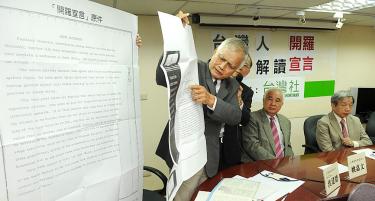
Former Examination Yuan president Yao Chia-wen, center, and Taiwan Society chairman Chang Yen-hsien, right, listen as Sim Kiantek speaks yesterday at a press conference in Taipei on interpreting the Cairo Declaration.
Photo: Wang Min-wei, Taipei Times

President Ma Ying-jeou’s (馬英九) interpretation of the Cairo Declaration, issued on Dec. 1, 1943, as the legal basis of Taiwan’s “return” to the Republic of China (ROC) after World War II was not only incorrect, but also dangerous because his rhetoric was exactly the same as that of Beijing, pro-independence advocates said yesterday.

“[Ma’s interpretation] fits right in with the ‘one China’ framework, which would be interpreted by the international community as saying Taiwan is part of China because hardly anyone would recognize the China in ‘one China’ framework as referring to the ROC,” Taiwan Society President Chang Yen-hsien (張炎憲), a former president of the Academia Historica, told a press conference.

Read more...


Taiwan’s sovereignty challenged by Beijing

The declaration by China that it is imposing an air defense identification zone (ADIZ) just north of Taiwan has far-reaching consequences and implications for peace and stability in the region, as well as for Taiwan’s sovereignty.

Peace and stability are threatened because this is yet another unilateral step by China in its strategy to impose its dictates on surrounding countries.

Read more...
 

Resolution urges air zone protest


Members of the Taiwan Solidarity Union take over the podium at the legislature in Taipei yesterday as Legislative Speaker Wang Jin-pyng steps in to sort out the issue.
Photo: Wang Yi-sung, Taipei Times

The legislature’s caucus leaders, including the Chinese Nationalist Party (KMT), yesterday approved a non-binding resolution demanding that President Ma Ying-jeou’s (馬英九) administration lodge an official protest with China over its unilateral demarcation of an air defense identification zone (ADIZ) in the East China Sea.

The resolution asks Ma to file a stern protest against the Chinese demarcation, which it said has destabilized regional stability, and to take concerted action with the nation’s democratic allies by refusing to submit flight plans as Beijing has requested.

Read more...


Page 939 of 1529

Newsflash

A major new bill to strengthen and enhance the Taiwan Relations Act (TRA) has been introduced to the US Congress by Representative Ileana Ros-Lehtinen, chairperson of the House of Representatives Foreign Relations Committee.

“With the TRA and the 2000 Taiwan Relations Enhancement Act, it is the most important piece of Taiwan legislation in the US Congress over the past 30 years,” said Coen Blaauw, an executive with the Formosa Association For -Public Affairs.

Known as the “Taiwan Policy Act of 2011,” the bill may have enough bipartisan support to pass the Republican-controlled House, but it is likely to have a harder time in the Senate.