Taiwan Tati Cultural and Educational Foundation

 
  • Increase font size
  • Default font size
  • Decrease font size
Home The News

News

Ma’s speech vague, conflicting: analysts


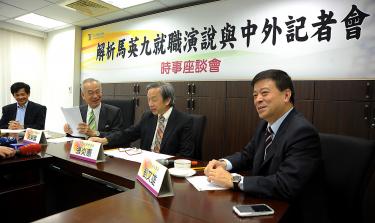
Academia Sinica researcher David Huang, Taiwan Brain Trust president Wu Rong-i, Taiwan Association of University Professors president Chang Yen-hsien and People First Party Deputy Secretary-General Liu Wen-hsiung, left to right, speak at a forum about President Ma Ying-jeou’s inauguration speech in Taipei yesterday.
Photo: Liu Hsin-de, Taipei Times

President Ma Ying-jeou’s (馬英九) inaugural speech on Sunday was vague, conflicting and cliched, addressing neither what should be done to solve domestic economic woes nor uphold Taiwan’s sovereignty, political analysts told a forum yesterday.

The president did not address what he would do to rejuvenate Taiwan’s economy, nor did he apologize for a series of ill-advised policies, such as fuel and electricity price increases and the controversy over imports of meat containing the feed-additive ractopamine, said Wu Rong-i (吳榮義), president of the Taiwan Brain Trust think tank, which organized the forum.
Read more...


Former DPP chairman goes on a hunger strike


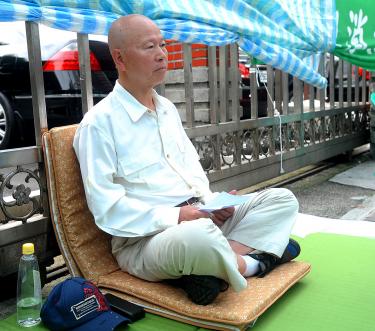
Former Democratic Progressive Party chairperson Hsu Hsin-liang, who has gone on a hunger strike over President Ma Ying-jeou’s policies, sits in the lotus position at the gate of the Legislative Yuan in Taipei on Monday.
Photo: Lin Cheng-kung, Taipei Times

Former Democratic Progressive Party (DPP) chairperson Hsu Hsin-liang (許信良) yesterday finished the first day of his hunger strike in front of the legislature after receiving no response from President Ma Ying-jeou (馬英九) to three demands he made on Sunday.

The 70-year-old Hsu said he would not back down until Ma concedes.

Read more...


Page 172 of 250

Newsflash


Japanese Prime Minister Shinzo Abe, top center, inspects troops during a military review at the Japan Ground Self-Defense Force’s Asaka training ground near Tokyo yesterday.
Photo: AFP

Japanese Prime Minister Shinzo Abe told Japanese troops yesterday that Japan would not tolerate the use of force to change the region’s “status quo,” comments likely to rile Beijing, which is locked in a long and bitter territorial dispute with Tokyo.

“Use of force for changing the status quo” is an expression often used by Japanese politicians and security experts to indirectly refer to what they see as China’s aggressive maritime expansion in the East China Sea and the South China Sea.