


After a tariff agreement was reached this week addressing key economic issues, Taiwan and the US can now focus more on security cooperation in the Indo-Pacific region, a former White House official said on Friday.
Alexander Gray, who served as deputy assistant to the president and chief of staff of the US National Security Council during US President Donald Trump’s first term, made the comments in an interview with the Central News Agency.
Gray called the trade deal a “very positive development in the US-Taiwan relationship,” as Washington has had several disagreements with Taiwan on trade matters over the years, going back to the first Trump administration.
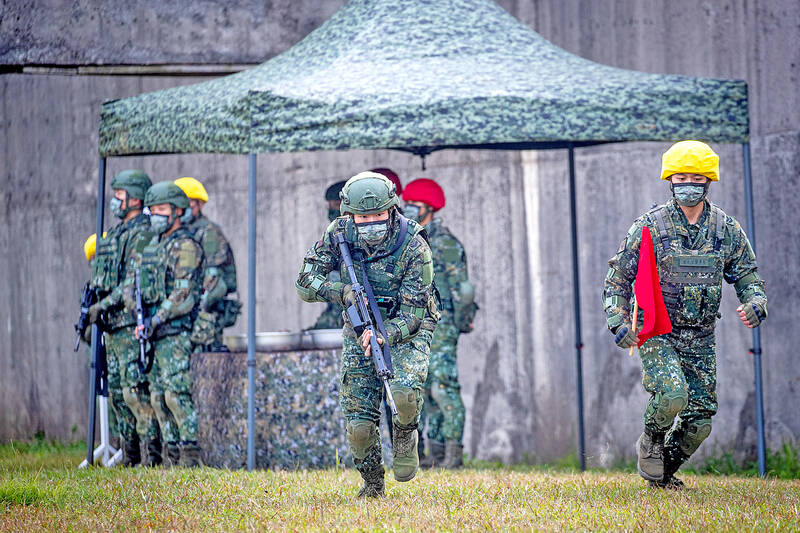
Military personnel participate in a training exercise at a military base in Taoyuan in an undated photograph.
Photo: Ritchie B. Tongo, EPA
The deal is a step toward resolving US concerns about semiconductor imports, which have long been a major source of friction between the two sides, he said.
However, with the issue taken off the table for the time being, “there’s a huge opportunity for the US and Taiwan to focus on strengthening our partnership and security, strengthening our regional collaboration and deterrence in the Indo-Pacific,” he added.
The Executive Yuan on Friday said the US agreed to lower tariffs on Taiwanese goods from 20 percent to 15 percent, without stacking them on existing most-favored-nation rates.
Meanwhile, Taiwanese semiconductor, electronics manufacturing services, artificial intelligence and energy companies would invest US$250 billion in the US based on their own plans.
Additionally, the government has pledged to provide up to US$250 billion in credit guarantees for financial institutions to support investments the semiconductor, and information and communications technology sectors would make in the US.
Gray, CEO of American Global Strategies, an international strategic advisory firm, said the arms deal that was approved and sent to Taiwan late last year sends a “great signal” to Beijing that the US remains steadfast in following the Taiwan Relations Act and the Six Assurances.
The US government last month announced the potential sale of eight arms packages to Taiwan, including M142 High Mobility Artillery Rocket Systems, anti-tank missiles and drones, at an estimated total cost of US$11.1 billion.
Gray said he hoped the deal leads to more arms sales over the coming year, but acknowledged that the US has a significant delivery backlog in arms deliveries to Taiwan.
As the US works to expand its defense industrial base, the country needs to make sure that it is “not just doing new sales, but actually delivering on the weapons Taiwan has already purchased,” he added.
Source: Taipei Times - 2026/01/19
Add this page to your favorite Social Bookmarking websites


