


The Constitutional Court yesterday ruled that amendments to the Constitutional Court Procedure Act (憲法訴訟法) passed by the Legislative Yuan last year are unconstitutional, as they contravene due legislative process and separation of powers.
The Legislative Yuan on Dec. 20 last year passed amendments stipulating that no fewer than 10 grand justices must take part in deliberations of the Constitutional Court, and at least nine grand justices must agree to declare a law unconstitutional.
The Executive Yuan on Jan. 2 requested that lawmakers reconsider the bill, but the Legislative Yuan, under a combined majority of Chinese Nationalist Party (KMT) and Taiwan People’s Party (TPP) legislators, rejected the motion.
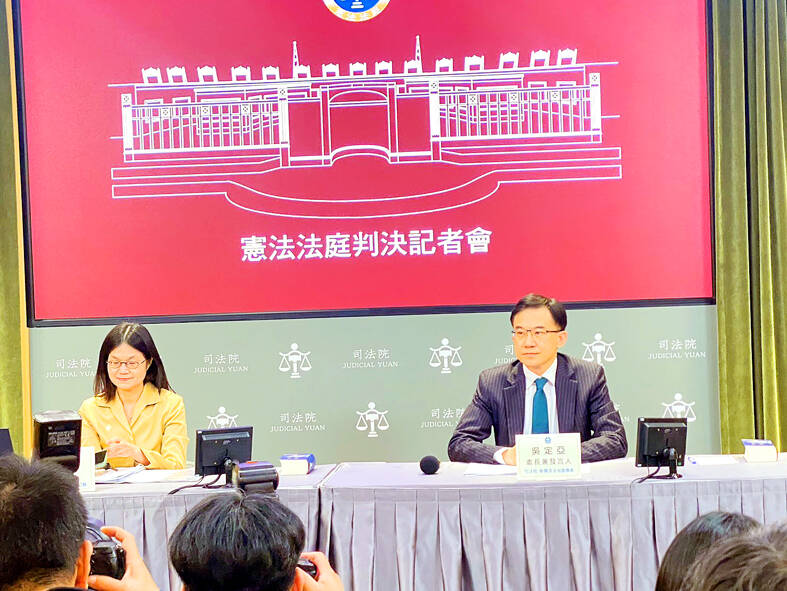
Consitutional Court Director of the Secretariat Hsu Pi-hui, left and spokesperson Wu Ding-ya hold at a news conference in Taipei yesterday.
Photo: Yang Hsin-hui, Taipei Times
The Democratic Progressive Party (DPP) caucus then filed for a constitutional interpretation of the bill, and the court accepted the case on May 14.
The Constitution stipulates that the Constitutional Court shall have 15 grand justices. The terms of seven grand justices ended on Oct. 31 last year, but opposition lawmakers in July rejected all of President William Lai’s (賴清德) grand justice nominees.
Lai has not nominated a new set of nominees since.
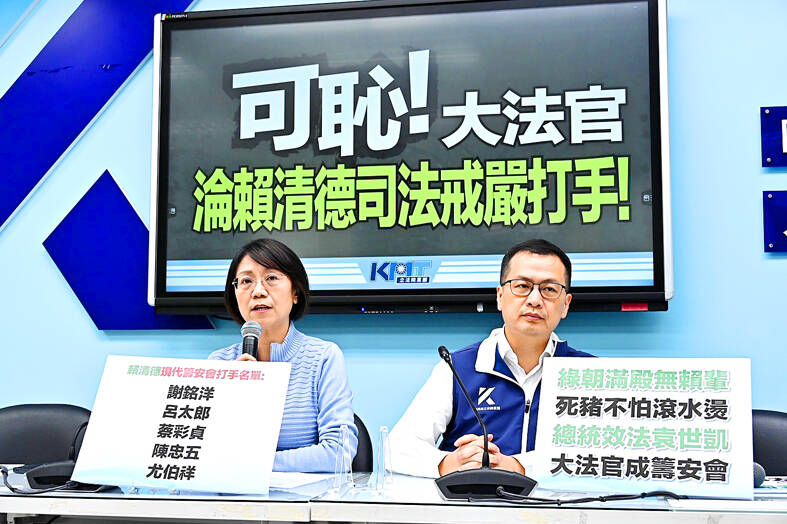
Chinese Nationalist Party (KMT) Legislator Weng Hsiao-ling, left, speaks as KMT caucus secretary-general Lo Chih-chiang looks on at a news conference in Taipei yesterday.
Photo: Tu Chien-jung, Taipei Times
Five of the remaining grand justices ruled the bill unconstitutional, handing down the Court’s first judgement this year.
The bill’s legislative process contained clear and serious procedural flaws, contravening the Constitution’s requirements of due legislative process, and breaks the principle of separation of powers.
The other three justices said the judgement is invalid, as amendments promulgated in January stipulate that the Court must have 10 grand justices to deliberate.
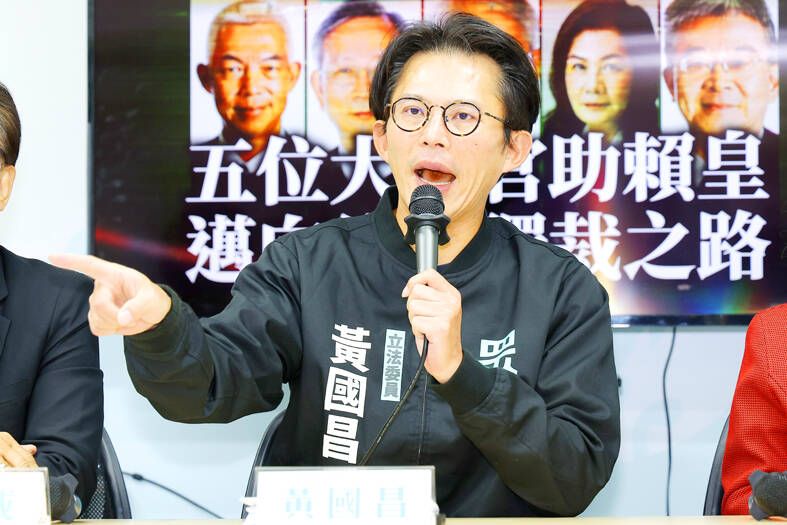
Taiwan People’s Party Chairman Huang Kuo-chang speaks at a news conference in Taipei yesterday.
Photo: CNA
DPP caucus chief executive Chung Chia-pin (鍾佳濱) said it is gratifying that citizens’ constitutional rights would have protection again, now that the Constitutional Court could return to functioning properly.
“Its rulings are above partisan party politics, and can curtail the authority of the Executive Branch,” DPP deputy chief executive Fan Yun (范雲) said. “It is the last line of defense for Taiwan democracy.”
The KMT slammed the Constitutional Court for convening a session despite having only eight grand justices, saying it contravened the law.
“This has buried the independence of our judiciary,” it said, adding the that the Court aimed “to clear obstacles for Lai to realize a ‘green dictatorship’ where executive, legislative and judicial powers are consolidated.”
According to the revised and the original version of the constitutional litigation law, at least six justices are required to convene a session, the KMT said.
“The Constitutional Court session was therefore held illegally, and the ruling is, of course, illegal,” it added.
TPP Chairman Huang Kuo-chang (黃國昌) said the ruling effectively aligned with Lai, fostering the development of a “green dictatorship.”
As three of the grand judges did not participate in the court hearings and instead submitted legal opinions outside the court, rather than issuing dissenting opinions within the ruling, “this highlights the illegality of the Constitutional Court’s composition,” he said.
Additional reporting by Jason Pan and Shih Hsiao-kuan
Source: Taipei Times - 2025/12/20
Add this page to your favorite Social Bookmarking websites


