


The US Congress has released a new draft of the National Defense Authorization Act (NDAA), which includes up to US$1 billion in funding for Taiwan-related security cooperation next year.
The version published on Sunday by US House of Representatives Speaker Mike Johnson removed earlier language that would have invited Taiwan to participate in the US-led Rim of the Pacific Exercise (RIMPAC).
A statement on Johnson’s Web page said the NDAA “enhances U.S. defense initiatives in the Indo-Pacific to bolster Taiwan’s defense and support Indo-Pacific allies.”
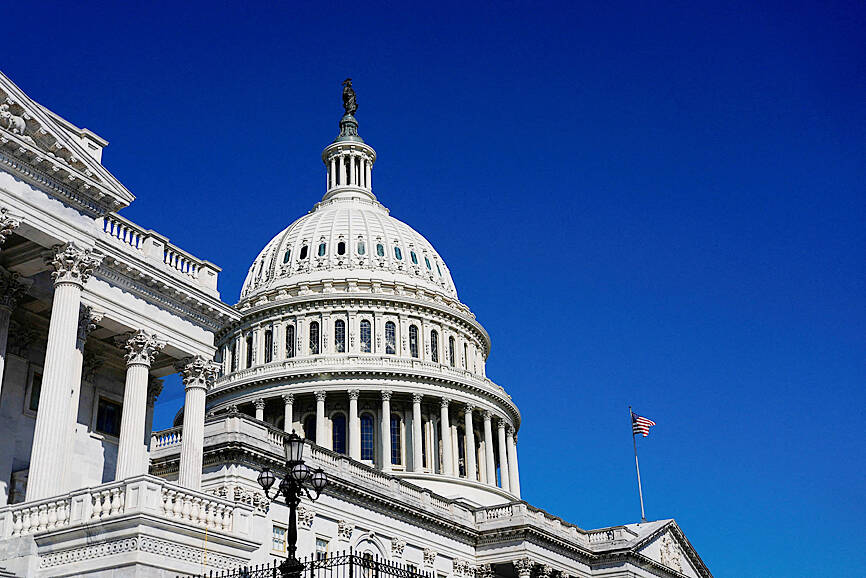
The US Capitol building in Washington is pictured on Sept. 19.
Photo: Reuters
The bill would require the US secretary of defense to “enable fielding of uncrewed and anti-uncrewed systems capabilities” with Taiwan by March 1 next year.
The systems must comply with the Taiwan Relations Act, and be usable by Taiwanese and US forces, it said.
Up to US$1 billion of the fiscal budget for next year could be allocated to support security cooperation initiatives with Taiwan, and to expand its medical equipment, supply capacity and combat casualty-care capabilities, the draft said.
The new version was produced after the US Senate and the US House of Representatives combined their versions into a unified bill.
The draft requires annual reports to the US Congress through 2029 on reciprocal procurement memoranda, and authorizes planning for joint maritime operations and leadership training between the US Coast Guard and Taiwan’s Coast Guard Administration.
Projected 2026 to 2030 costs include deployments of US Coast Guard operational training teams to Taiwan to improve maritime security, law-enforcement capacity and deterrence.
The US secretary of defense’s office would be required to submit a Taiwan security assistance road map, and a study assessing Washington’s rapid mobilization, deployment and sustainment abilities in responding to potential conflicts in the Taiwan Strait, the South China Sea and other Indo-Pacific hotspots, the bill said.
It would also evaluate joint and allied operational capacity, with particular focus on coordination with Taiwan, Japan, Australia and the Philippines, it added.
Final funding levels would depend on future appropriations legislation.
“This legislation includes important House-passed provisions to ensure our military forces remain the most lethal in the world and can deter any adversary,” Johnson said. “[US] President [Donald] Trump has made clear the past few decades of investments propping up communist China’s aggression must come to an end, and this bill includes important guardrails to protect America’s long-term investments, economic interests and sensitive data.”
Source: Taipei Times - 2025/12/09
Add this page to your favorite Social Bookmarking websites


