


The Constitutional Court yesterday ruled that most of the amendments passed by the legislature expanding its power to oversee the executive branch of government are unconstitutional, including those that would have given lawmakers broader investigative powers.
The ruling dealt a blow to opposition Chinese Nationalist Party (KMT) and Taiwan People’s Party (TPP) legislators, who used their combined majority to push through the amendments to the Act Governing the Legislative Yuan’s Power (立法院職權行使法) and the Criminal Code on May 28.
The Constitutional Court found revisions that permit investigative committees in the legislature to request information from officials, military personnel and representatives of public or private entities to be unconstitutional.
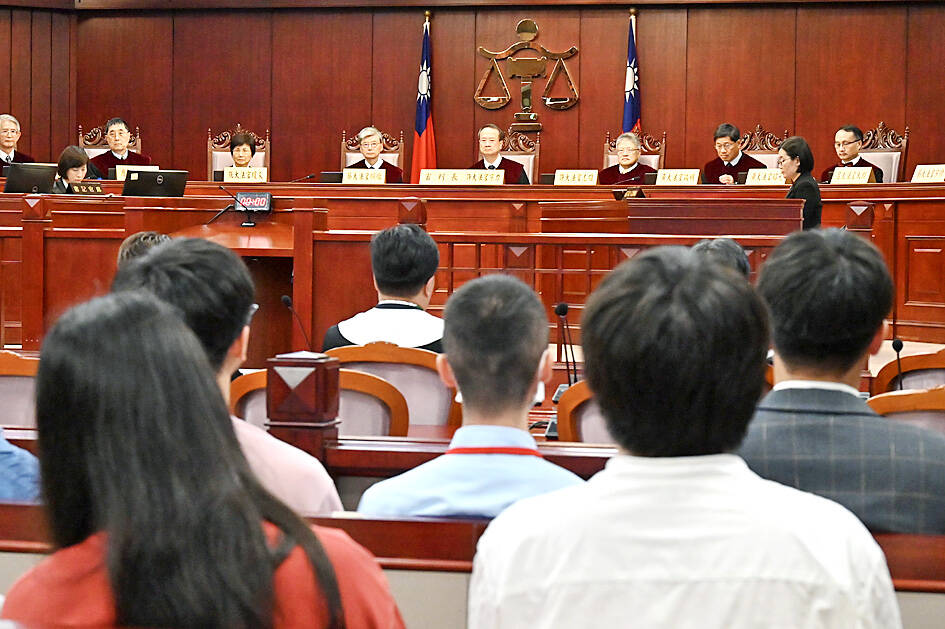
Constitutional Court justices present a ruling on amendments expanding the legislature’s oversight powers in Taipei yesterday.
Photo: George Tsorng, Taipei Times
It did not shut down the idea of the legislature setting up committees to conduct investigations, but allowed legislators only to look into matters “significantly related to specific proposals” that fall within their powers endowed by the Constitution.
Measures allowing the legislature to impose penalties on people who refuse to hand over information or attend hearings, or those who give false testimony, were also overturned by the ruling, effective immediately upon its issuance.
The court also ruled against measures obliging the president to deliver a state of the nation address on the legislative floor and then take questions from lawmakers, saying such arrangements should be decided through negotiations between the president and the lawmaking body.
The ruling was not surprising, given that it aligned closely with the court’s injunction issued on July 19, which already halted the enforcement of many of the amendments that went into effect on June 26.
The case was brought by the Democratic Progressive Party (DPP) caucus, President William Lai (賴清德), the Executive Yuan and the Control Yuan nearly four months ago.
KMT caucus secretary-general Lin Tzu-ming (林思銘) expressed “great sadness” at the decision, telling reporters that the court had unfairly sided with the DPP.
“This is a very great constitutional crisis and a great disgrace to constitutionalism,” he said. “Judicial independence is dead, and we must speak out.”
The caucus would conduct a line-by-line analysis of the ruling as soon as possible to determine whether to further amend the law or take other corresponding measures, Lin added.
TPP caucus whip Huang Kuo-chang (黃國昌) said the party would propose its own amendment to the law.
However, the internal logic of the court’s decision is “so confusing, it will make subsequent attempts to amend the law difficult,” he added.
Huang cited for example the decision to make “anything involving false statements unconstitutional,” as holding hearings and refusing to answer questions are legal, but imposing penalties for lying is not.
Premier Cho Jung-tai (卓榮泰) said that the Executive Yuan admires and respects the judges’ decision to safeguard constitutional order, maintain the separation of powers, protect democratic values and protect people’s rights.
DPP caucus whip Ker Chien-ming (柯建銘) called the judgement “the most important in [Taiwan’s] history of constitutional government.”
“There is no such thing as a loser or a winner. We hope that all lawmakers ... will start anew and unite under the Constitution so that the country can move forward and our democracy can continue to develop,” Ker told reporters.
Additional reporting by Lin Hsin-han, Liu Wan-lin and Chung Li-hua
Source: Taipei Times - 2024/10/26
Add this page to your favorite Social Bookmarking websites


