


Taiwan would have 24-hour access to low Earth orbit satellites by the end of this month through service provided by Eutelsat OneWeb as part of the nation’s effort to enhance signal resilience, a Chunghwa Telecom Co (中華電信) official said yesterday.
Earlier this year the Ministry of Digital Affairs, which partnered with Chunghwa Telecom on a two-year project to boost signal resilience throughout the nation, said it reached a milestone when it made contact with OneWeb’s satellites half of the time.
It expects to have the capability to maintain constant contact with the satellites and have nationwide coverage by the end of this month, Chunghwa Telecom copresident Alex Chien (簡志誠) said.
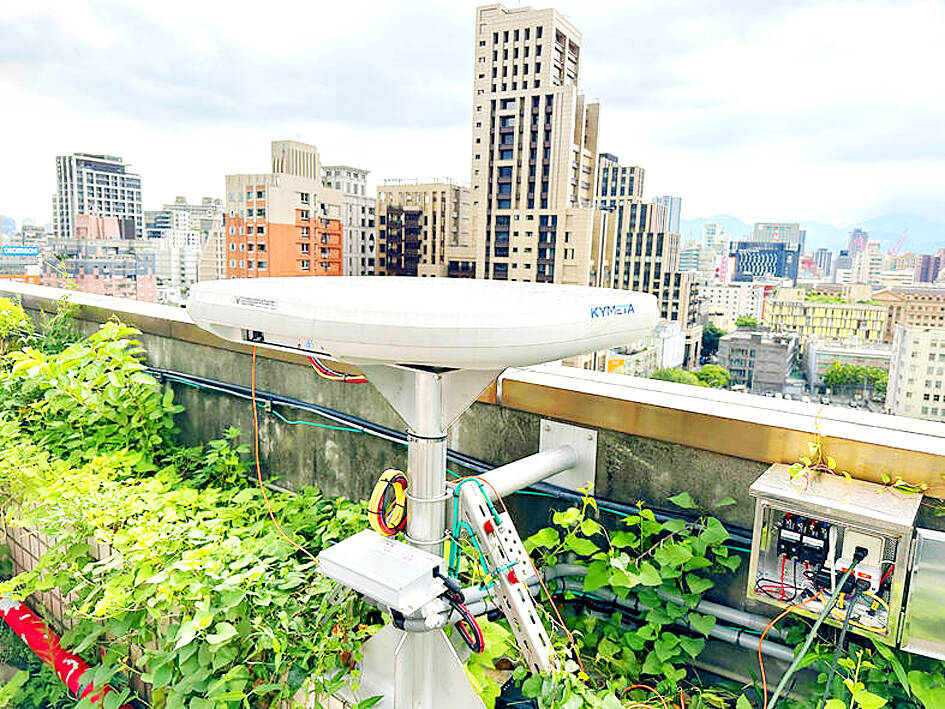
OneWeb low Earth orbit satellite terminal equipment on the rooftop terrace of the Ministry of Digital Affairs building in Taipei is pictured in an undated photograph.
Photo: CNA
To ensure that the nation’s communication network can operate through non-geosynchronous satellites, a network that incorporates satellite equipment has been installed in Taiwan and other countries, as well as low and medium orbit satellites, he said.
The low orbit satellites are operated by OneWeb, while the medium orbit satellites are operated by satellite provider SES, he said.
“For the satellite system to operate normally, it requires three major elements: satellites in the sky, terminal equipment and ground receiving stations. All three are indispensable,” he said.
The terminal equipment used in the network includes 700 sites in Taiwan and abroad, and the ground receiving stations are set up in Japan, Thailand and Guam, he said.
“Initially there were some problems with the ground receiving station in Thailand, but OneWeb has solved the issue,” he said.
However, operating ground equipment at the sites requires trained personnel, and the ministry hopes to have the system ready by the end of the year, he said.
As for whether the network could be used by Taiwan’s business community, Chien said that since satellites have less bandwidth, most corporate customers would still use submarine cables with their larger bandwidths.
However, the satellite-based system could still be used as a backup for businesses, he said.
Department of Communications and Cyber Resilience Director-General Cheng Ming-tsung (鄭明宗) previously said that after obtaining complete coverage, which includes Taiwan proper, as well as outlying islands and counties, “we no longer need to be afraid of natural disasters or other emergencies that could knock out our communications.”
“If systems are broken, we can still provide the military and political bodies with communications through satellites,” he said. “We can make emergency calls and conduct command and dispatch.”
Source: Taipei Times - 2024/10/14
Add this page to your favorite Social Bookmarking websites


