


US President Joe Biden, Japanese Prime Minister Fumio Kishida and Philippine President Ferdinand Marcos Jr on Thursday reiterated the importance of cross-strait peace and stability during their first-ever trilateral summit at the White House in Washington.
“We affirm the importance of peace and stability across the Taiwan Strait as an indispensable element of global security and prosperity, recognize that there is no change in our basic positions on Taiwan, and call for a peaceful resolution of cross-Strait issues,” the leaders said in a joint statement.
Taiwan welcomes the statement of concern and steadfast support for peace and stability across the Strait from the heads of state of the US, Japan and the Philippines, Presidential Office spokesperson Olivia Lin (林聿禪) said in Taipei.
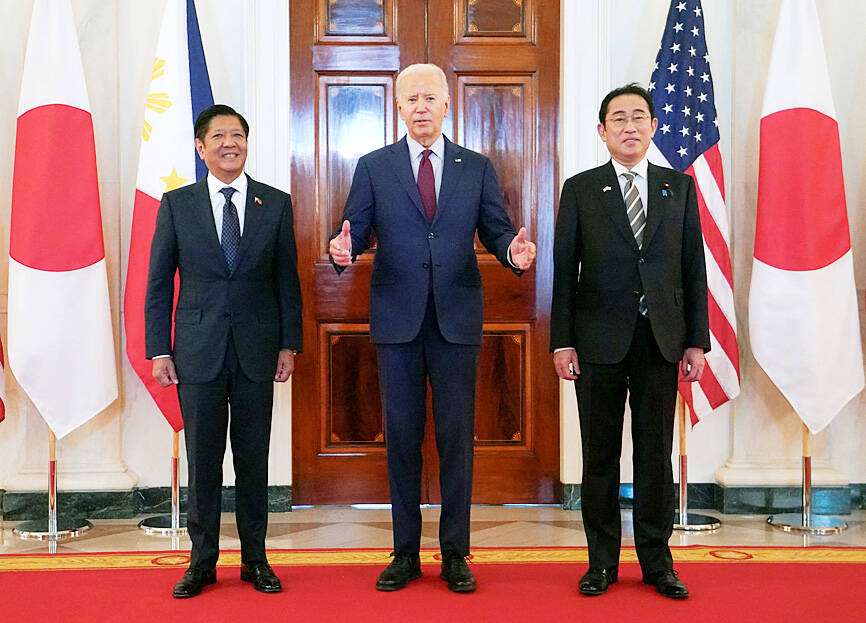
US President Joe Biden, center, speaks while escorting Philippine President Ferdinand Marcos Jr, left, and Japanese Prime Minister Fumio Kishida to their trilateral summit at the White House in Washington on Thursday.
Photo: Reuters
The joint statement showed that an international consensus has formed on protecting peace amid expanding authoritarianism that threatens global security and order, she said.
Taiwan will continue to build up its self-defense capabilities and cooperate with like-minded countries to safeguard the rules-based international order and contribute to global peace, stability and prosperity, Lin said.
The Ministry of Foreign Affairs added that Taiwan is a responsible international actor willing to collaborate with the three nations on maintaining peace, stability and prosperity across the Indo-Pacific region.
The trilateral summit cemented the US-Japan-Philippines joint security mechanism, which forms part of a larger defense network against China, Su Tzu-yun (蘇紫雲), a research fellow at the Taipei- based Institute for National Defense and Security Research, told a forum in Taipei.
He cited discussions between Biden and Kishida on what is being called the greatest upgrade to the Treaty of Mutual Cooperation and Security between the US and Japan since 1960, which would see the two countries engage in more coordinated command between US forces stationed in Japan and the Japan Self-Defense Forces.
This security network can operate in tandem with existing US-UK-Australia and US-Japan-South Korea security mechanisms to form a comprehensive regional security network against China, Su said.
Liao Hsiao-chuan (廖小娟), an associate professor of political science at National Taiwan University, said the trilateral summit marked Japan’s ascent from a regional ally to a global partner of the US’ global security strategy.
The summit also hinted at a potential growth of the US-led security framework in the region, as a strengthened Japan might provide a much-needed counterweight to China and North Korea should the US become isolationist by electing Donald Trump as president, she said.
The alliance between the US, Japan and the Philippines would be strong because of their shared interests in democratic values and the freedom of navigation in the region, said Hsiao Hsiu-an (蕭琇安), an associate research fellow at National Chengchi University’s Institute of International Relations.
However, Institute for National Policy Research senior adviser Lo Chih-cheng (羅致政) said that the US’ efforts to shore up the Indo-Pacific is more remedial than suggestive of a military alliance.
Taiwan can find cause for caution in Washington’s flawed security strategy, inability to counter China’s “gray zone” tactics and Trump, he said.
Additional reporting by CNA
Source: Taipei Times - 2024/04/13
Add this page to your favorite Social Bookmarking websites


