


A nuclear-propelled US submarine has arrived in South Korea in the second deployment of a major US naval asset to the Korean Peninsula this month, South Korea’s military said yesterday, adding to the allies’ show of force to counter North Korean nuclear threats.
The USS Annapolis arrived at a port on Jeju Island about a week after the USS Kentucky docked at the mainland port of Busan.
The Kentucky was the first US nuclear-armed submarine to visit South Korea since the 1980s. North Korea reacted to its arrival by test-firing ballistic and cruise missiles in apparent demonstrations that it could make nuclear strikes against South Korea and deployed US naval vessels.
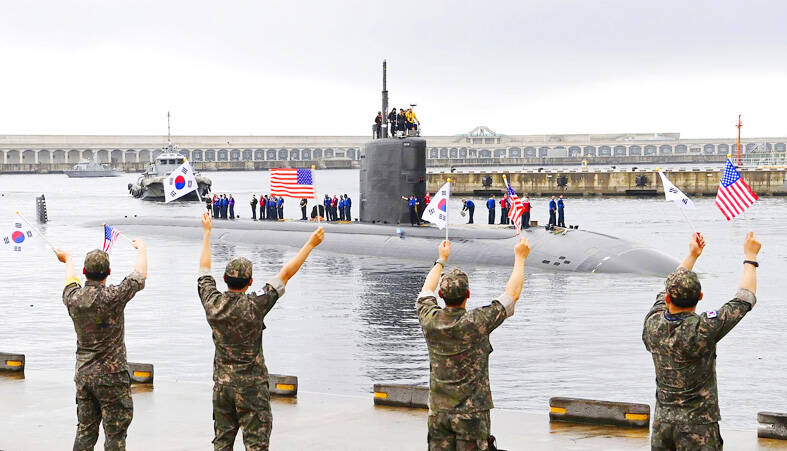
South Korean navy sailors wave as the nuclear-powered submarine USS Annapolis arrives at a naval base on Jeju Island, South Korea, yesterday.
Photo: AP / South Korean Ministry of National Defense
In between those launches, North Korea’s defense minister issued a veiled threat insisting the Kentucky’s docking in South Korea could be grounds for Pyongyang to use a nuclear weapon against it. North Korea has used similar rhetoric before, but the statement underscored how much relations are strained.
The Annapolis, whose main mission is destroying enemy ships and submarines, is powered by a nuclear reactor, but is armed with conventional weapons.
The Annapolis docked at Jeju mainly to load supplies, but Jang Do-young, a spokesperson for the South Korean navy, said the US and South Korean militaries were discussing whether to arrange training involving the vessel.
Meanwhile, the US-led UN Command yesterday said it had started a conversation with North Korea about US Private Travis King who last week ran into the North across one of the world’s most heavily fortified borders.
Andrew Harrison, a British lieutenant general who is the deputy commander at the UN Command, refused to say when the conversation started, how many exchanges have taken place and whether the North Koreans responded constructively, citing the sensitivity of the discussions.
He also declined to detail what the command knows about King’s condition.
Source: Taipei Times - 2023/07/25
Add this page to your favorite Social Bookmarking websites


