


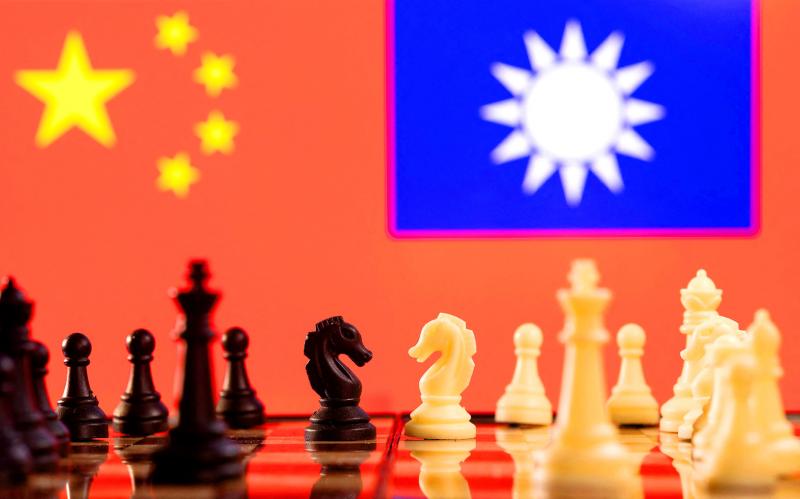
China has changed tactics in its cognitive warfare campaign against Taiwan, now favoring divisive negative stories about Taiwanese society, rather than positive stories about China, an Academia Sinica researcher wrote in a recently published paper.
“In the past, when its economy was strong, China liked to use positive propaganda, including proposing a number of incentives and measures to attract Taiwanese,” Hung Tzu-wei (洪子偉), an associate research fellow at the academy’s Institute of European and American Studies, said on Friday.
However, with its economy disrupted by the US-China trade war, the COVID-19 pandemic and other factors, China has gradually turned toward “mobilizing negative sentiment,” for example, by spreading false reports on key social issues to divide Taiwanese, he said.
It also creates negative sentiment and division through unilateral actions, such as banning imports of Taiwan’s agricultural products, he said.
Hung, who also conducts research for the Institute for National Defense and Security Research, analyzed data collected over two years from China’s cognitive warfare efforts against Taiwan, using the data to make predictions about China’s actions and ways to counter those actions.
His research was compiled into a paper published on July 19 in Oxford University’s Journal of Global Security Studies.
In his research, Hung found that even among people who reject fake news stories, there is still an impact through the energy spent on the cognitive processing of the false information.
Some of the disinformation created by Chinese content farms includes stories that aim to cause animosity toward the US, for example, by emphasizing incidents of racism toward minorities in the US, or by creating the narrative that the US turns its back on its allies, he said.
Hung said social media could affect China’s efforts in both positive and negative ways.
For example, young people in Taiwan are more media literate and able to see through Chinese propaganda — often using it as content for memes to satirize it, he said.
On the other hand, Taiwanese youth often access content through Chinese Web sites, or use Chinese social-media platforms like Tik Tok, which puts them at risk, he said.
“We should be vigilant, but not overly worried. Cognitive warfare is a good exercise for the immune system of a democracy,” he said.
Hung suggested the government combat China’s cognitive warfare efforts by improving transparency.
Citing examples, he said the Australian government regularly reports on the activities of foreign forces, requires academics and the media to disclose funding, and places restrictions on companies or media platforms that contravene fair competition.
“It is also important to fight back. China’s online cognitive warfare against Taiwan dropped sharply during its suppression of the Hong Kong pro-democracy movement,” he said.
“That means that China cannot win two cognitive wars at the same time,” he said.
Source: Taipei Times - 2022/08/02
Add this page to your favorite Social Bookmarking websites


