


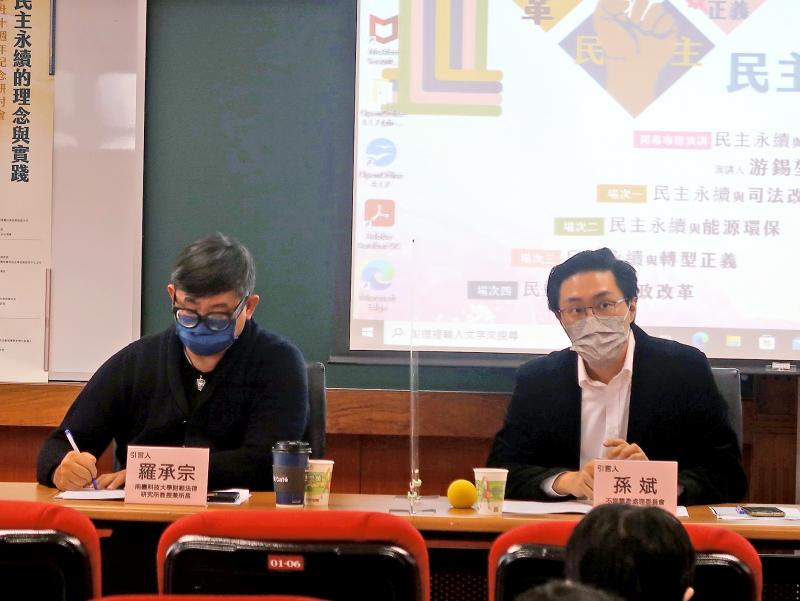
A failure to sufficiently implement transitional justice measures could threaten democracy, the Ill-gotten Party Assets Settlement Committee said yesterday.
Committee vice chairman Sun Pin (孫斌) made the statement during a forum on democracy hosted by the legal reform group Taiwan Forever Association in Taipei.
“Taiwan’s staggered implementation of efforts to democratize has meant that transitional justice work that should have been carried out from the beginning has been delayed 30 years,” Sun said.
Injustices of the past could reoccur if transitional justice is not well implemented, he said.
While no universal definition of “transitional justice” exists, most academics define it as measures taken by a country to address the aftermath of human rights abuses, he said.
“An important part of that process is to affirm the human dignity of the victims of past political persecution, and to use appropriate means to ensure there are no future victims,” he said.
“Looking at the operation of Taiwan’s democratic systems, you can see how transitional justice has not been implemented well enough,” he said.
The use of terms such as “green terror” and “democratic autocracy” shows a lack of understanding of the White Terror era, and are used to attack the normal administrative measures of a sound democratic government and its transitional justice efforts, he said.
“The result is that the meaning behind those original terms, such as ‘White Terror,’ become muddled, and those guilty of injustices escape responsibility,” he said.
“The public will grow distrustful of all government, and believe that all parties are equally incorrigible,” he added.
By manipulating the public’s trust in the government, anti-democratic forces try to present themselves as a better alternative, which could easily lead to a regression of democracy, he said.
Source: Taipei Times - 2022/01/17
Add this page to your favorite Social Bookmarking websites


