Taiwan Tati Cultural and Educational Foundation

 
  • Increase font size
  • Default font size
  • Decrease font size
Home The News News Bundestag votes to expand Taiwan ties

Bundestag votes to expand Taiwan ties


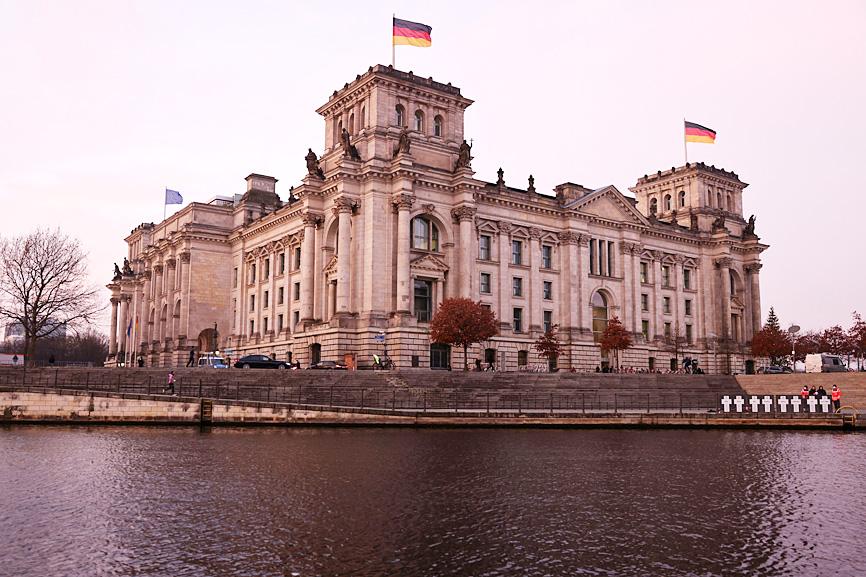
The Reichstag, which houses the Bundestag, is pictured in Berlin on Wednesday.
Photo: Reuters

The German Bundestag has passed a resolution calling on the government to reassess its Taiwan policy and deepen exchanges with Taipei, but ruled out the possibility of establishing diplomatic relations with Taiwan.

The Petitions Committee of Germany’s new parliament, which met for the first time in October following a federal election in September, passed the resolution on Thursday.

The committee also referred an earlier motion on establishing formal diplomatic relations with the Republic of China to the German Federal Foreign Office and each parliamentary caucus.

The resolution says that since the Federal Republic of Germany and the People’s Republic of China established diplomatic relations in 1972, Berlin has adhered to the “one China” policy, which excludes the possibility of forging diplomatic ties with Taiwan.

However, Germany is supportive of conducting close political, economic and social engagements with Taiwan, and expanding cooperation with Taipei is in the interests of Germany and Europe, it states.

In light of the rapidly changing international situation, the German government should re-evaluate its policy toward Taiwan, including potentially recognizing it as a sovereign state, and considering deepening exchanges and cooperation, the resolution says.

The motion asking Germany to establish diplomatic relations with Taiwan was initiated by German national Michael Kreuzberg in May 2019, and received more than 50,000 signatures in October of that year, requiring that it be sent to the Bundestag for discussion.

The Petitions Committee held a public hearing on the motion in December 2019.

At the hearing, Petra Sigmund, director-general for Asia and the Pacific at the German Federal Foreign Office, said Taiwan and Germany share values, such as democracy and freedom, and conduct frequent exchanges in the economic, cultural and academic spheres.

Germany plans to expand ties with Taiwan, she said.

However, Germany excludes the possibility of establishing diplomatic ties with Taiwan under its “one China” policy, Sigmund said.

The petition was subsequently shelved.

Taiwan’s representative office in Germany welcomed the passage of the resolution on Thursday and thanked German lawmakers for supporting improved relations with Taiwan, saying that it looks forward to seeing the German government’s response to the motion.


Source: Taipei Times - 2021/12/13


Add this page to your favorite Social Bookmarking websites
Reddit! Del.icio.us! Mixx! Google! Live! Facebook! StumbleUpon! Facebook! Twitter!  
 

Newsflash

The odds of President Ma Ying-jeou (馬英九) being re-elected in 2012 yesterday fell below 50 percent for the first time since May, according to a university prediction market.

Prediction markets are speculative exchanges, with the value of an asset meant to reflect the likelihood of a future event.

On a scale from NT$0 to NT$100, the probability of Ma winning a re-election bid was, according to bidders, NT$48.40, the Center for Prediction Market at National Chengchi University said.

The center has market predictions on topics including politics, the economy, international affairs, sports and entertainment. Members can tender virtual bids on the events, with the bidding price meant to reflect probability.

The re-election market had attracted 860,000 trading entries as of yesterday. It was launched in April.

The center said the figure slipped 2.3 percentage points yesterday from a day earlier, when Ma conceded that his party did not fare as well as hoped in the “three-in-one” elections.

The Chinese Nationalist Party (KMT) won 12 of Saturday’s 17 mayor and commissioner elections, but its total percentage of votes fell 2 percentage points from 2005 to 47.88 percent of votes nationwide.

The Democratic Progressive Party (DPP) won just four of the races, but received 45.32 percent of the ballots, or a 7.2 percentage-point increase from 2005.

Since the center opened the trading on Ma’s re-election chances on April 11, prices have largely hovered around NT$60, but jumped to NT$70 in mid-June. The figure then fell to NT$51.80 in August after Typhoon Morakot lashed Taiwan, killing hundreds.

After then-premier Liu Chao-shiuan (劉兆玄) resigned in September, the price returned to NT$63.2 and remained at around NT$60 for the following two months, the center said.

Since Ma took over as KMT chairman, the center said the number had steadily declined from NT$58 on Nov. 18 to NT$50.80 on Dec. 5. After Saturday’s elections, the figure fell below NT$50.

The center said the outcome yesterday would likely affect next year’s elections for the five special municipalities, as well as the next presidential election.

It also said the probability of Taipei Mayor Hau Lung-bin (郝龍斌) winning re-election was 72 percent, while the chances of Taipei County Commissioner Chou Hsi-wei (周錫瑋) winning again were 20 percent.

Source: Taipei Times 2009/12/07