


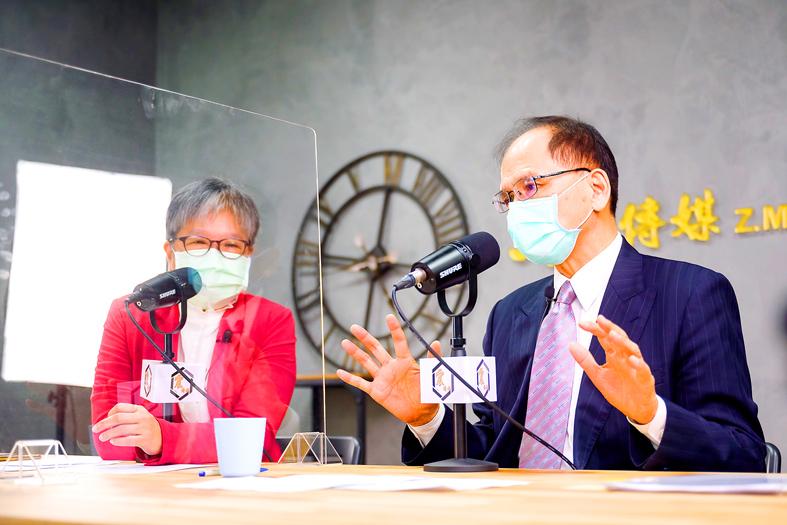
Taiwan’s status would be normalized if the US resumed diplomatic ties with Taiwan, Legislative Speaker You Si-kun (游錫堃) said yesterday, adding that the issue of Taiwan’s identity has been gaining attention worldwide.
You made the remarks in an interview with media personality Frances Huang (黃光芹) in a program streamed by Internet outlet Z Media.
Last year, then-US secretary of State Mike Pompeo said that “Taiwan has not been a part of China,” You said.
At the Tokyo Olympic Games, Taiwanese athletes could be heard calling themselves Taiwanese and foreign media outlets calling the country Taiwan, “signaling a breakthrough of the Taiwanese identity in public consciousness,” he said.
Taiwanese must unite to overcome the challenges in the movement to rectify the nation’s name, You said, adding that the promotion of Taiwan must be carried out tactfully to protect the rights of Taiwanese athletes.
The only remaining barrier to Taiwan returning to the UN and a normal state is the restoration of formal ties between Taiwan and the US, he said.
You said he has pushed for the implementation of the National Normalization Resolution (正常國家決議文) since 2007, when he was the chairman of the Democratic Progressive Party (DPP), and has continued to fight for Taiwan’s normalization as the legislative speaker.
Asked about possible constitutional amendments, You expressed reservation and highlighted the difficulties such proposals must overcome.
Lawmakers have sent 56 proposed amendments to the Legislative Yuan Constitutional Amendment Committee and they are expected to file more, he said.
These include 18 separate proposals to lower the minimum age for voting and running for office, abolishing the Examination Yuan and the Control Yuan, and seven others to change the Republic of China Constitution, he said.
A popular vote on prospective constitutional amendments have to be held concurrently with the nine-in-one local elections in November next year, lest they secure insufficient votes to clear the legal threshold, he said.
Given this constraint, lawmakers will have to pass the floor vote on the constitutional amendments before March 29 next year, he said.
“This is a very tight timetable,” he added.
Asked about Taiwan Affairs Office spokeswoman Zhu Fenglian (朱鳳蓮) on Wednesday last week warning You and other DPP members against promoting Taiwanese independence or normalization at the risk of being punished by Beijing, You said he has never been shy to admit that he is a Taiwanese independence advocate.
Former Chinese Communist Party leader Mao Zedong (毛澤東) and former Chinese premier Zhou Enlai (周恩來) also supported Taiwanese independence in the 1930s and 1940s, You said, adding that Beijing should punish them, too.
Source: Taipei Times - 2021/08/06
Add this page to your favorite Social Bookmarking websites


