


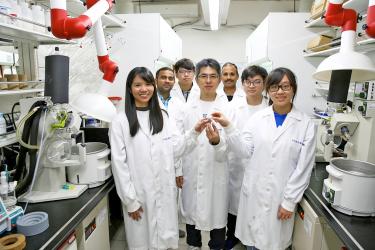
Academia Sinica yesterday said that its researchers have developed an antibody testing method for COVID-19 and have made progress synthesizing remdesivir, a medicine that many believe could cure the infection.
The Centers for Disease Control on Tuesday sent serum samples to Academia Sinica of three people who had contact with Taiwan’s first COVID-19 fatality, as part of an effort to determine the source of that infection.
The three had tested negative for RNA viruses, but the centers hoped to discover if they had developed antibodies.
Test results showed that only one sample had antibodies for COVID-19 and SARS, Academia Sinica Institute of Biomedical Sciences research fellow Lin Yi-ling (林宜玲) said.
The sample was obtained from a Taiwanese businessperson who was not listed as a confirmed case, because their immune system beat the virus, she said.
Little is known about COVID-19, so it is still a mystery whether a person who has recovered from it can contract it again, she added.
The method is useful in tracing the transmission chain of a certain case, Institute of Plant and Microbial Biology Director Wu Shu-hsing (吳素幸) said, but added that testing for RNA viruses tells whether a person contracts COVID-19.
Using molecular biology and genetic engineering, Wu said that she pieced together plasmids — a kind of DNA for expressing antigens — in small templates to make up longer series of plasmids for producing the antigens used to test for COVID-19, SARS and Middle East respiratory syndrome antibodies.
Ordering massive plasmid series from overseas manufacturers takes two to three weeks, Lin said, praising Wu’s team for only needing a week.
After Institute of Biological Chemistry associate research fellow Ho Meng-chiao (何孟樵) purified the nucleocapsid protein of COVID-19 for making reagents, Lin used the western blot method to place the antigens in a serum sample for testing antibody reactions, she said.
Another team led by Institute of Chemistry associate research fellow Chein Rong-jie (陳榮傑) succeeded in synthesizing 100mg of remdesivir in two weeks.
Unable to obtain the raw materials in time, they used materials on hand and molecule synthesis, referencing public-domain literature, to make the drug, which on Thursday was 97 percent as pure as the original, Chein said.
Before the centers tasked them with the mission, Academia Sinica President James Liao (廖俊智) last month formed a task force to speed up the development of antigens, antibodies, drugs and vaccines for COVID-19.
The synthesized drug cannot be used without the consent of the US pharmaceutical firm that manufactures remdesivir, Liao said.
Nonetheless, the achievement showed that Academia Sinica is capable of drug synthesis and could facilitate mass production of the drug after a technology transfer has been completed, he added.
Source: Taipei Times - 2020/02/22
Add this page to your favorite Social Bookmarking websites


