


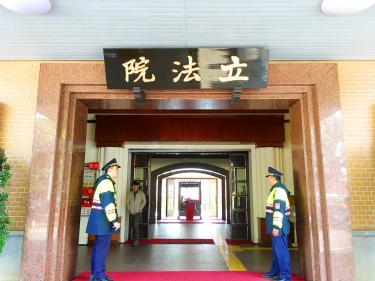
A draft amendment to broaden the definition of treason to include collusion with China has been submitted for legislative negotiations, with the first round of cross-caucus talks expected to begin tomorrow at the soonest.
Under the Criminal Code, treason through collusion must involve an “enemy state” and is therefore inapplicable to Taiwanese who spy for China.
The draft amendment, proposed by Democratic Progressive Party Legislator Wang Ting-yu (王定宇), seeks to expand the definition of treason to include collusion with an “enemy” — described in the proposal as any “country, political entity or organization that engages in armed conflict or a military standoff with the Republic of China,” or “posing a military threat to the nation.”
If passed, individuals caught colluding with China with the intent to subject Taiwan’s territory to its rule could be sentenced to death or life imprisonment.
The Criminal Code’s provisions on treason through collusion have been useless in practice, resulting in a serious flaw in the nation’s security, Wang said.
Considering that the draft involves the safety of 23 million Taiwanese, hopefully legislators across party lines would agree to pass it quickly without touching on the issue of the nation’s status, he said.
Only when the problem with the Criminal Code is solved can the government begin to deal with other issues in national security laws, he said.
Wang had previously cited as an example the case of retired vice admiral Ko Cheng-sheng (柯政盛), whose final assignment was deputy commander of the navy fleet.
Ko was sentenced by the Supreme Court in March 2015 to 14 months in prison for helping China set up a spy ring involving officers under his command and passing on classified military information to China, because the Criminal Code does not address Chinese espionage cases.
The amendment would close this loophole, Wang said.
Since the amendment was proposed in 2017, opposition parties have blocked it many times, he said.
“Now it has finally reached the final step,” he said.
Even if cross-caucus negotiations broke down, the amendment would still be put to a vote on the legislative floor, he said.
Source: Taipei Times - 2019/04/22
Add this page to your favorite Social Bookmarking websites


