


The details of a piece of US Senate legislation released on Wednesday revealed calls for US troops to participate in Taiwan’s military exercises and vice versa, a part of efforts by US lawmakers to support Taiwan amid what they see as a rising military threat from China.
The US Senate Committee on Armed Services on May 24 passed the National Defense Authorization Act (NDAA) for fiscal 2019, which includes several provisions aimed at strengthening Taiwan’s military capabilities.
Section 1243 of the act reiterates Washington’s decades-long stance that the Taiwan Relations Act and the “six assurances” are cornerstones of US-Taiwan relations.
In line with these cornerstones, the US should “strengthen defense and security cooperation with Taiwan to support the development of capable, ready and modern defense forces necessary for Taiwan to maintain a sufficient self-defense capability,” the bill reads.
The US secretary of defense should also promote US Department of Defense policies concerning exchanges that enhance the security of Taiwan, “including US participation in appropriate Taiwan exercises, such as the annual Han Kuang exercise” and vice versa, it says.
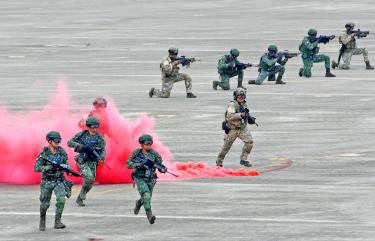
The Han Kuang military exercises are Taiwan’s largest annual military drills. They are held in two stages: computer-aided war games and live-fire drills staged nationwide.
This year’s computer-aided war games were held from April 30 to May 4. The live-fire exercises began on Monday and end today.
This year they featured Coast Guard Administration personnel and civilian drone operators for the first time, making use of all levers of national power in military planning, the Ministry of National Defense has said.
The Senate bill calls on both nations to expand cooperation in humanitarian assistance and disaster relief, and urges the secretary of defense to consider supporting a visit by a US hospital ship to Taiwan as part of the US Navy’s annual Pacific Partnership deployment to improve disaster response planning and readiness.
The bill must still be passed by the full Senate and signed by the president before it becomes law.
The US House of Representatives on May 24 passed its version of the fiscal 2019 NDAA.
The US Congress has over the years passed a number of pro-Taiwan laws to show support for the nation, including the Taiwan Travel Act in late February, which encourages meetings and visits by high-ranking US and Taiwanese government officials.
Asked for comment, Presidential Office spokesman Sidney Lin (林鶴明) yesterday expressed the government’s gratitude to the Senate for its support of Taiwan’s national security.
“Taiwan’s national security and self-defense capabilities will continue to be a focus for the government,” Lin said.
Ministry spokesman Major General Chen Chung-chi (陳中吉) also offered thanks to the Senate.
“Taiwan will gladly be a part of endeavors to promote regional security and stability,” Chen said.
Chen quoted Confucius’ saying that “virtue is not left to stand alone. He who practices it will have neighbors,” saying that the ministry believes that Taiwan would be able to work with other democratic nations.
Source: Taipei Times - 2018/06/08
Add this page to your favorite Social Bookmarking websites


