


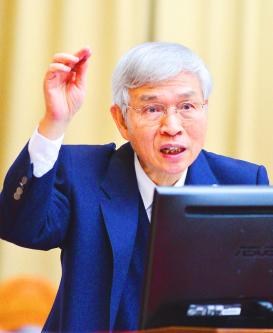
Central bank Governor Yang Chin-long (楊金龍) yesterday said the bank would remove authoritarian icons from the nation’s currency if explicit orders were given by the transitional justice promotion committee to be established by the Executive Yuan.
Yang made the remark at a meeting of the Legislative Yuan’s Finance Committee, after Chinese Nationalist Party (KMT) Legislator Lai Shyh-bao (賴士葆) asked whether the passage of the Act on Promoting Transitional Justice (促進轉型正義條例) would prompt changes to the design of the nation’s currency.
Although the act was promulgated last year, the central bank cannot make changes before the transitional justice promotion committee specifies which banknotes or coins contain authoritarian imagery, Yang said.
The act stipulates that the Cabinet is to create the nine-member transitional justice promotion committee to oversee the removal of authoritarian icons, the declassification of state archives and the rehabilitation of victims of persecution.
The committee is to be disbanded upon completing a full report on those tasks, the act says.
“Should the transitional justice promotion committee order a change to the design of the New Taiwan dollar, I believe we will have to discharge our duties according to the law,” Yang said.
Lai then asked Yang whether his comments could be interpreted as an unwillingness to follow the policy of his predecessor, former central bank governor Perng Fai-nan (彭淮南).
Lai also asked Yang whether he agrees that changing the design of the currency — which Lai said would cost NT$50 billion (US$1.7 billion) — would be a waste of taxpayer money for political purposes.
Yang responded to both questions in the negative, saying that the central bank decided during Peng’s tenure as governor that it would not change clearly apolitical and nonauthoritarian design elements of the currency.
In response to a question by Democratic Progressive Party (DPP) Legislator Liu Chien-kuo (劉建國), Yang said that the central bank does not currently have, or has ever had, a fixed limit on the upward movement of the NT dollar versus the US dollar.
Monetary policy observers have long called the exchange rate of NT$28.5 per US dollar the “Perng Fai-nan Line,” Li said, before asking Yang where he would draw the line on the NT dollar’s appreciation.
“I have followed Perng for a long time and I have never heard him say that we should hold this or that line in defense of our currency’s exchange rate,” Yang said.
The central bank would intervene and keep order if and when abnormal fluctuations occur in the market, he added.
Trying to reverse significant exchange rate fluctuations by force is counterproductive, Yang said, adding that the central bank favors a flexible approach to monetary policy.
The market yesterday appeared to respond to Lai’s comments by testing the central bank’s bottom line, with the NT dollar appreciating NT$0.057 to NT$29.200, its highest level since Jan. 31, when it reached NT$29.150.
The NT dollar yesterday opened at NT$29.245, moving between NT$29.180 and NT$29.250 before the close.
Source: Taipei Times - 2018/03/16
Add this page to your favorite Social Bookmarking websites


