


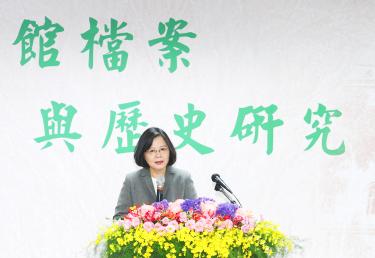
President Tsai Ing-wen (蔡英文) yesterday said that her administration would continue work to declassify old government records as part of its transitional justice efforts.
Tsai made the remarks at the opening of a symposium hosted by the Academia Historica in Taipei.
Declassifying old government records is not just for transitional justice, but it also befits the government’s “open government” ideals and allows public access to government information, Tsai said.
While the Academia Historica is tasked with managing presidential and vice presidential records and artifacts, Tsai said that the Academia Historica belongs to the public, and that academics and members of the public are welcome to make use of archived documents so that with critical analysis of historical truth, there can be a more diverse explanation of the nation’s history.
Tsai applauded the Academia Historica under the leadership of president Wu Mi-cha (吳密察) for having swiftly compiled 260,000 documents for online publication.
“Without the limitation of time and space, members of the public and researchers can freely browse the archive, which is of great help to the development of research on history,” Tsai said of the institute’s publication in April of formerly confidential government archives dating to Chiang Kai-shek’s (蔣介石) regime.
The files, accessible on the institution’s archive at http://ahonline.drnh.gov.tw, were uploaded in several batches between January and April after being individually reviewed between August and December last year.
The collection includes documents related to the Northern Expedition — a Chinese Nationalist Party (KMT) campaign led by Chiang against local warlords in China from 1926 to 1928; the Second Sino-Japanese War; Taiwan-China unification plans and government suppression of civil strife, the institute said.
The collection includes manuscripts, electronic documents, letters, books, maps, photographs and other articles, the institute said, adding that they represent 98.8 percent of all existing documents related to Chiang.
The remainder includes items that cannot be posted due to copyright restrictions (0.74 percent) and some that are restricted due to privacy concerns (0.44 percent), while 0.02 percent are permanently confidential to protect intelligence sources, it said.
Source: Taipei Times - 2017/06/25
Add this page to your favorite Social Bookmarking websites


