


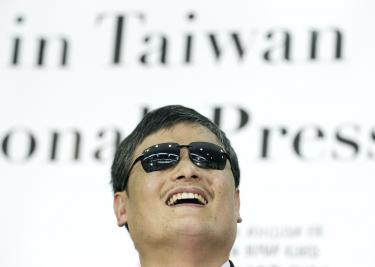
Taiwan’s leaders appear to have a lack of understanding of “the essence of Beijing’s authoritarian regime,” despite Taiwan serving as a role model for democratic development in China, Chinese activist Chen Guangcheng (陳光誠) said in Taipei yesterday.
Chen, who has been living in the US after fleeing China in May last year, told an international press conference on the first full day of his 18-day visit to Taiwan, that President Ma Ying-jeou’s (馬英九) refusal to meet him “reflected the fierce competition between a democracy and an authoritarian regime.”
Legislative Speaker Wang Jin-pyng (王金平) also turned down the opportunity to meet the 41-year-old dissident during his visit, which has been dubbed as a “trip for human rights” by its main organizer, the Taiwan Association for China Human Rights.
Visiting Taiwan for the first time, the activist said the success of Taiwan’s democratic development has proven Beijing’s rhetoric that democracy is not suited for the Chinese world to be a lie that “couldn’t be more wrong.”
However, Chen expected Taiwan to stand firm on its democratic system and “engage more with China’s political leaders, but also with its rights activists because they represent the real voice of the people.”
Accompanied by members of his family and his mentor, New York University (NYU) law professor Jerome Cohen, Chen faced the press conference — which attracted more than 100 reporters, and included more than 40 international media outlets — with confidence.
He carefully handled more than 20 questions on various topics, such as his plans after finishing his fellowship at NYU, a suspected attempt to hack into his personal computer by Beijing and his observations on democracy in Taiwan, without undue elaboration.
Chen refrained from criticizing Taiwanese politicians or democratic developments in Taiwan and Hong Kong, which one reporter described as “eroding.”
“If Hong Kong fails to transplant the rule of law to China, Beijing will eventually bring the rule of man to Hong Kong. If Taiwan does not help democratize China, the authoritarian system of government will someday return to intimidate Taiwan,” Chen said.
With regard to his future, Chen said he does not rule out any possibilities, including where he would live, but said he is determined to fight the Chinese Communist Party regime, which imprisoned him between 2006 and 2008, and afterward placed him under house arrest.
Speaking with confidence, Chen said he would “definitely return to China” and that he believed he had done the right thing and “struck Beijing in its Achilles’ heel,” which is what caused it to retaliate so strongly against him.
Chen is scheduled to deliver a speech titled “Human rights as the foundation of cross-strait peace” at the Legislative Yuan and visit Jingmei Human Rights Memorial Park in the outskirts of Taipei today.
He is also scheduled to unveil his new book, titled China, the Book of Living and Dying, at a press conference in Taipei tomorrow.
Source: Taipei Times - 2013/06/25
Add this page to your favorite Social Bookmarking websites


