


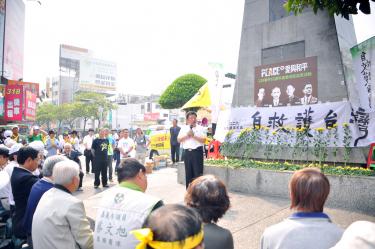
Vice President Vincent Siew (蕭萬長) yesterday paid tribute to a prominent victim of the 228 Massacre, Dr Pan Mu-chih (潘木枝), at a commemorative exhibition held to mark the 65th anniversary of his execution and to honor his dedication to the development of democracy in Taiwan.
Joined by family members of victims of the 228 Massacre, Siew attended the memorial exhibition titled: “The burning incense stick: 65 years of memories of the late doctor Pan Mu-chih,” held by the Memorial Foundation of 228.
Not long after the 228 Incident had begun, Pan conducted negotiations with Chinese Nationalist Party (KMT) troops at Chiayi Airport on behalf of that city’s 228 Settlement Committee. However, he was detained by government troops during the negotiations and was executed in front of Chiayi Railway Station on Mar.25, 1947.
The 228 Massacre refers to a bloody crackdown by KMT troops on an anti-government uprising that began on Feb. 27, 1947.
“Doctor Pan was not only my life-saver, but my mentor,” Siew said in a memorial film for Pan titled Died for the people, died with honor (為市民而亡,身雖死猶榮), which premiered at the exhibition yesterday.
Siew said Pan’s public execution left a lasting and a distressing memory because he had often received care from the doctor as a child.
“My mother had once said to me that without doctor Pan, I might not have lived to adulthood. He was a kind man not only to me, but also to each and every one of his patients,” Siew said.
Aside from his devotion to his patients, Pan also had been a key influence in Taiwan’s democratic development: He gave his life for Taiwan and for the people of Chiayi, Siew said.
“To commemorate the selfless sacrifice of doctor Pan, we must move forward with Taiwan’s democratic development and set the nation on a better direction,” Siew said.
The commemorative exhibition opened yesterday in the National 228 Memorial Museum and is scheduled to run through April 29.
Translated by Stacy Hsu, Staff Writer
Source: Taipei Times - 2012/03/26
Add this page to your favorite Social Bookmarking websites


