


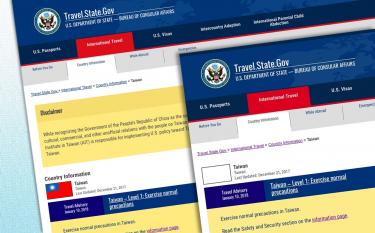
The Ministry of Foreign Affairs yesterday expressed its disappointment over the removal of the Republic of China (ROC) flag from several US government Web sites, saying it has conveyed its grave concerns to Washington.
The ministry made the remarks hours after the Chinese-language United Daily News reported the disappearance of the ROC flag from the Web sites of the US Department of State’s Bureau of Consular Affairs and the Office of the US Trade Representative that displayed the flag on their introduction pages for Taiwan.
The newspaper published screenshots of the Taiwan introduction page on the US trade office’s Web site, one from June last year and the other from Tuesday, to show the removal of the flag.
The US Department of State made the change on its Web site in September last year.
The ministry talked to the US about the matter several months ago, ministry spokesman Andrew Lee (李憲章) told a news conference in Taipei.
“That is why we found the latest flag removal from the Web sites of the two US government agencies not only unthinkable, but also unacceptable and disappointing,” Lee said, adding that Taipei has expressed its serious concerns to Washington.
The US had previously repeatedly reassured the ministry that Taiwan-US ties remained solid and that there was no shift in its policy, Lee said.
“However, we believe that such cases [the removal of the ROC flag] could influence the Taiwanese public’s perception of the status of relations between the two nations,” he said.
The ministry has taken note of Beijing’s increased attempts to use its “sharp power” to squeeze Taipei’s space within international organizations and oppress Taiwan on the supposedly free and open Internet, Lee said.
Such attempts are not conducive to the development of cross-strait ties, Lee added.
“Sharp power,” a term coined by the US-based National Endowment for Democracy, a non-profit organization that promotes democracy, refers to authoritarian efforts to “influence their target audiences by manipulating or distorting the information that reaches them.”
American Institute in Taiwan spokeswoman Sonia Urbom reiterated that the US’ policy toward Taiwan has not changed.
“The United States remains committed to our ‘one China’ policy based on the three joint communiques and the Taiwan Relations Act,” Urbom said.
Source: Taipei Times - 2018/01/25
Add this page to your favorite Social Bookmarking websites


