


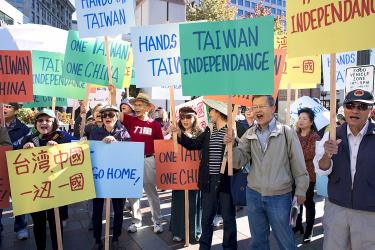
US officials are reassuring Taiwan that no matter what Chinese President Xi Jinping (習近平) says about it during his summit with US President Barack Obama this week, Washington will not change its current policies.
“It is normal for a Chinese leader to raise Taiwan,” US Assistant Secretary of State for East Asia and Pacific Affairs Daniel Russel told a media briefing on Tuesday.
“We will always make clear when the issue arises that we place great importance on stability across the [Taiwan] Strait,” he said. “We respect the right of the people on Taiwan to exercise their democratic rights and will continue to counsel restraint on the part of Beijing in order to maintain trust and stability.”
Speaking at the same event, Daniel Kritenbrink, senior director for Asian affairs at the US National Security Council, said that the US respected Taiwan’s democratic process and had a long-standing position on cross-strait issues based on the “one China” policy, the six communiques and the Taiwan Relations Act (TRA).
“Our fundamental interest is in cross-strait stability,” he said.
Russel said that the US had an immensely complex relationship with China, one that was anchored in a commitment to prevent strategic rivalry and to ensure “we are working to reconcile our respective legitimate interests.”
“We are digging down on problem areas. That will be a significant dimension of the summit. We do not paper over our differences with China on important issues,” he said. “We have serious differences over what constitutes acceptable behavior in cyberspace and in maritime space — particularly in the South China Sea.”
He said there were also differences on human rights and the treatment of civil society, as well as financial and regulatory policy. Russel said that the US was not trying to contain China and that US policy was not hostile.
“The same rights that apply to the big and strong apply similarly to the small and weak. Freedom of navigation and freedom of over-flight are not rights that one country grants to another,” he said.
“Strong and important countries like China have to ensure that small neighbors have the ability to exercise those same rights,” he said.
Xi arrived in Seattle on Tuesday and is to meet with Obama at the White House later today and tomorrow.
As Xi arrived, the New York Times said that the US and China had been negotiating what could become the first arms control accord for cyberspace with a goal of announcing an agreement during Xi’s visit.
According to the newspaper, the deal would safeguard critical infrastructure during peacetime, but was not expected to cover contentious issues such as the theft of intellectual property or data.
An article by Bloomberg predicted that Xi’s visit would be overshadowed by China’s growing military assertiveness, its expanding economic espionage and its crackdown on human rights at home.
“We have to be cognizant the level of anxiety, competition and tension in our relationship is here to stay,” former US Department of State official Kurt Campbell was quoted as saying by Bloomberg.
Source: Taipei Times - 2015/09/24
Add this page to your favorite Social Bookmarking websites


